
Spis treści
Wprowadzenie
Tape-in hair extensions have become an established option for adding length, density, and color dimension while maintaining a relatively flat attachment profile. Unlike strand-by-strand fusion systems, tape extensions use thin adhesive sections that hold extension hair close to the natural hair, allowing stylists to cover a larger area with fewer attachment points.
However, choosing a tape extension should involve more than looking at the finished hairstyle. Tape width, PU construction, adhesive consistency, hair quality, sectioning, placement, maintenance, and removal all affect the final result.
For salons, distributors, private-label brands, and other professional users, these details matter even more. A tape extension product must not only look natural when first installed but also offer consistent construction and specifications across repeated use. This guide explains how tape-in extensions work, their main advantages and limitations, suitable applications, and the factors professionals should examine when evaluating them.
Czym są przedłużanie włosów taśmą?
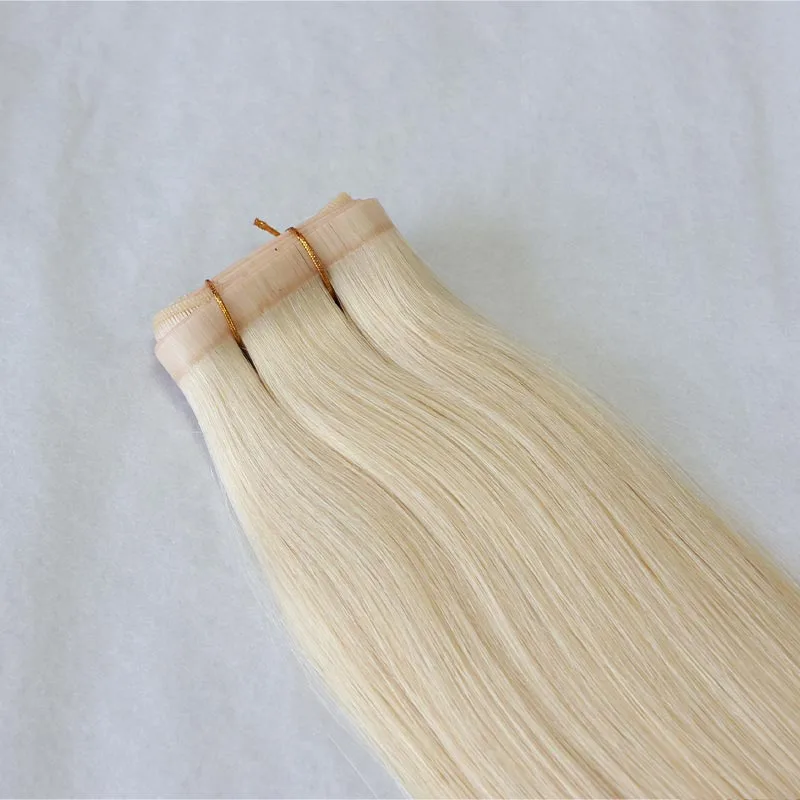
Tape-in hair extensions are pre-sectioned extensions with thin adhesive tabs positioned at the top of each hair piece. During installation, a stylist separates a controlled section of natural hair and places the extension tabs around or alongside it according to the selected application technique.
The attachment is designed to remain relatively flat against the head.
This distinguishes tape extensions from keratin-tip systems, which use many small bonded strands, and from wefts, which place a larger continuous track of hair across a section of the head.
A well-designed tape system aims to balance several characteristics:
- a discreet attachment area;
- sufficient adhesive stability;
- controlled extension weight;
- even hair distribution;
- comfortable placement;
- convenient professional removal and reapplication.
The attachment itself is only one part of the product. The quality and processing of the human hair are equally important to how the extensions look, move, style, and blend after installation.
How Do Tape-In Hair Extensions Work?
Most tape extension systems use a thin polyurethane, or PU, section at the top of the hair.
An adhesive layer is applied to this section. During professional installation, the natural hair is carefully separated and positioned so that the extension lies flat without unnecessary pulling.
One common method places natural hair between two tape pieces, creating a relatively thin “sandwich.” Other application patterns may be used according to the extension design, hair density, stylist technique, and desired result.
Because the attachment covers a wider area than an individual keratin bond, the extension hair can be distributed across the section rather than concentrated at a single connection point.
Correct section size remains important. Too much natural hair can reduce attachment effectiveness, while too little may create unnecessary tension.
Why Are Tape Extensions So Popular?
One reason tape-in hair extensions are widely used is that they offer a useful combination of speed, discretion, and versatility.
For an experienced stylist, applying tape sections can generally be more straightforward than installing a large number of individual bonded strands. The flat PU tabs can also remain difficult to detect when they are correctly positioned beneath the surrounding natural hair.
This makes the system useful for customers who want additional length or volume without highly visible attachment points.
Tape systems can also support different styling objectives. Instead of using the same number of pieces for every client, the stylist can vary placement according to the desired result.
Someone seeking modest fullness may need a different layout from someone seeking substantial length and volume.
Main Advantages of Tape-In Hair Extensions
Flat Attachment Profile
One of the most recognizable characteristics of tape extensions is the flat connection area.
A well-constructed PU tape section can sit close to the scalp rather than creating a noticeably raised bond. This can make the attachment easier to conceal under appropriately sectioned natural hair.
For customers concerned about visible extension connections, this is an important advantage.
Efficient Professional Application
Tape pieces cover more width than individual keratin strands, allowing stylists to add hair across a section efficiently.
This does not eliminate the need for skilled installation. Correct positioning, clean sectioning, weight distribution, and alignment remain essential.
However, the basic structure makes tape extensions attractive to salons that regularly perform extension services.
No Heat Fusion During Standard Installation
Traditional tape extension application relies on adhesive rather than melting a keratin bond with a heating tool.
This makes it fundamentally different from U-tip, V-tip, or other fusion-based extension systems.
Customers specifically looking for an extension technique without heat fusion may therefore consider tape systems.
Flexible Placement
Tape sections can be distributed strategically around the head.
A stylist may use them to increase overall length, add fullness through the sides and back, strengthen sparse-looking ends, or introduce dimensional color.
This flexibility allows the application pattern to be adapted instead of following one fixed layout for every client.
Suitable for Professional Customization
For B2B markets, tape extensions can be developed across a range of specifications.
The Sasil PU Tape Hair Extension is offered with customizable options including hair length, color, texture, weight, and packaging, allowing professional buyers to configure a range around their market requirements.
What Are the Limitations of Tape-In Hair Extensions?
A balanced product guide should also consider the situations in which tape extensions require additional attention.
Adhesive Areas Require Proper Care
The attachment area should be treated differently from the mid-lengths and ends of the hair.
Applying inappropriate oils, conditioners, or styling products directly around adhesive sections may interfere with attachment performance.
Clients therefore need clear aftercare instructions from their stylist.
Placement Can Affect Hairstyling
Although tape tabs are flat, they are wider than individual strand connections.
If extensions are installed too close to the hairline, parting area, or other highly visible locations, they may become easier to see when the hair is tied up or restyled.
Placement should therefore consider how the customer normally wears their hair.
Maintenance Is Still Necessary
Tape extensions are not a permanent installation.
As natural hair grows, the attachment gradually moves farther away from the scalp. Professional maintenance allows the stylist to remove, inspect, and reposition the extensions when appropriate.
The maintenance interval can vary according to natural hair growth, extension construction, care habits, and salon recommendations.
They Are Not Automatically Suitable for Every Hair Condition
Fine hair and thin hair are not identical conditions.
Some customers naturally have fine strands but healthy density, while others may have active thinning, breakage, scalp conditions, or weakened hair.
Extension weight and attachment should therefore be selected according to the condition of the natural hair rather than simply choosing a method because it is described as “lightweight.”
Tape-In Hair Extensions at a Glance
| Factor | Przedłużanie włosów Tape-In |
|---|---|
| Załącznik | Thin adhesive tape/PU section |
| Installation Style | Section-based |
| Heat Fusion | Not normally required |
| Connection Profile | Płaski |
| Typical Goal | Length, volume, color dimension |
| Placement Flexibility | High |
| Maintenance | Periodic professional repositioning |
| Removal | Professional adhesive-release process |
| Best Evaluation Factors | Hair quality, PU construction, adhesive consistency, weight and placement |
| Professional Skill | Recommended |
This combination helps explain why tape extensions are used across many different salon environments, but the final result still depends heavily on installation and product quality.
Who Are Tape-In Hair Extensions Best For?
Tape-in hair extensions may be suitable for clients who want a balance between discreet attachment and noticeable additional hair.
They can be particularly useful for people seeking:
- additional overall length;
- fuller-looking mid-lengths and ends;
- increased density;
- dimensional color without coloring every section of natural hair;
- a relatively flat extension connection;
- an extension system without heat-fused bonds.
Their suitability should still be determined individually.
For example, a client who frequently wears very high ponytails may require a different placement strategy from someone who normally wears their hair down. A client with delicate areas around the temples may also require extensions to be positioned away from those sections.
The method should adapt to the wearer, not the other way around.
Are Tape-In Extensions Good for Fine Hair?
Tape systems are often considered for fine hair because their attachment is thin and distributes hair across a wider section than some strand-based methods.
But natural hair strength still matters.
A professional stylist should evaluate:
- strand thickness;
- overall density;
- existing breakage;
- hairline strength;
- scalp condition;
- previous chemical processing;
- extension weight.
The American Academy of Dermatology warns that extensions and hairstyles that continuously pull on natural hair can contribute to traction alopecia. Its guidance emphasizes avoiding painful or excessively tight extension styles and seeking professional installation. Read the dermatologists’ guidance on preventing hair damage from extensions.
The important principle is therefore not simply “tape extensions are suitable for fine hair.” The extension weight, placement, amount of natural hair supporting each attachment, and condition of that hair must all be appropriate.
Tape-In vs Keratin Hair Extensions
Tape and keratin systems achieve similar cosmetic objectives using very different attachment structures.
| Feature | Rozszerzenia taśmy | Keratin Extensions |
|---|---|---|
| Załącznik | Flat adhesive tab | Individual keratin bond |
| Application | Section based | Strand by strand |
| Heat Fusion | Usually no | Typically yes |
| Attachment Width | Wider and flatter | Małe pojedyncze punkty |
| Placement Precision | Section-based flexibility | Very high strand-level control |
| Maintenance Approach | Remove and reposition | Depends on bond system |
| Best Choice Depends On | Hair type, styling and maintenance preference | Hair type, stylist skill and desired placement |
Neither method should automatically be described as superior.
Tape systems may appeal to someone prioritizing flat attachments and efficient application. Keratin methods may be preferred when highly individualized strand placement is important.
For salons, offering more than one technique makes it easier to select an extension according to the customer’s natural hair rather than forcing every customer into a single method.
Tape-In vs Nano Ring Extensions
Nano rings attach extension strands with very small metal rings rather than adhesive.
This creates another important distinction.
Tape systems spread the extension across a wider section. Nano systems create multiple small individual connections.
A client looking specifically for an adhesive-free technique may prefer a ring-based method, while someone prioritizing a flat, section-based connection may prefer tape.
This is why product comparisons should focus on attachment mechanics and user requirements rather than simply declaring one method “better.”
Why PU Construction Matters
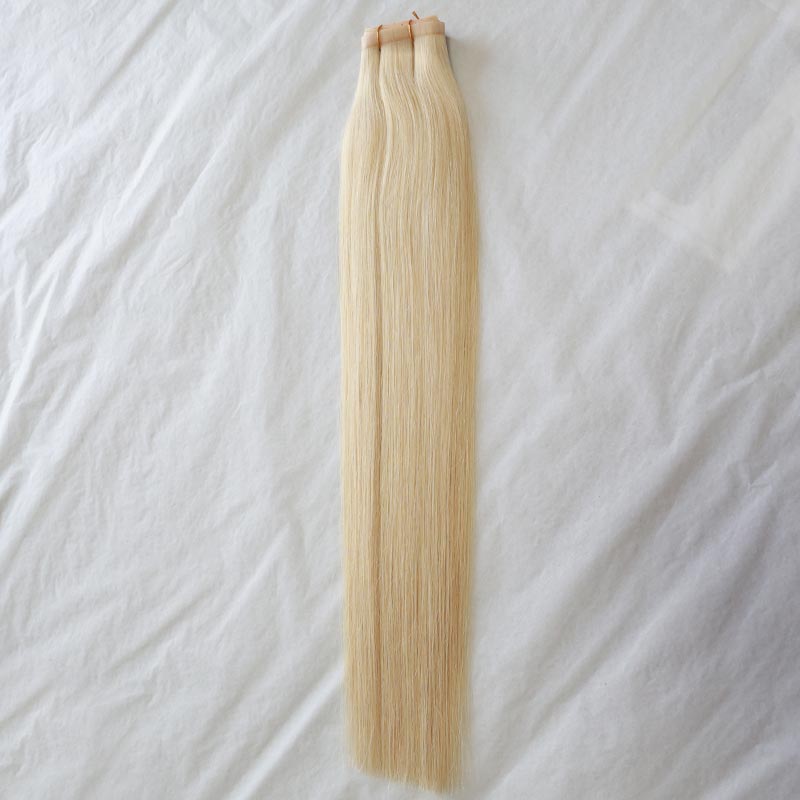
The top section of a tape extension performs several jobs simultaneously.
It holds the extension hair together, carries the adhesive, creates the connection area, and affects how noticeable the attachment feels beneath the natural hair.
PU construction should therefore be evaluated for:
- thickness;
- flexibility;
- edge finish;
- uniformity;
- hair distribution;
- consistency between pieces.
A thick or rigid top section may behave differently from a thin, flexible one.
For professional buyers comparing samples from different manufacturers, placing several unused tape sections next to each other can reveal differences in dimensions and construction that may not be obvious when examining only one piece.
Human Hair Quality Still Determines the Final Result
A good attachment cannot compensate for poor hair.
Tape-in extensions need hair that can blend naturally with the customer’s existing texture and continue to perform through normal washing, brushing, drying, and styling.
When evaluating human hair tape extensions, professional users should pay attention to:
Cuticle and Hair Alignment
Consistent strand direction can affect smoothness and manageability.
Density Through the Length
Some extensions become considerably thinner toward the ends, while others maintain greater fullness through the length.
The appropriate option depends on the intended market and hairstyle.
Color Consistency
Professional brands need predictable shades across repeated production.
This becomes particularly important when customers combine multiple packs during one installation.
Texture Consistency
Straight, wavy, and other textures should remain reasonably consistent within the same specification.
Shedding
Hair should be securely integrated into the tape section.
Unusual shedding during sample testing may indicate a construction issue worth investigating.
Color Matching Tape-In Extensions
Color matching has a major effect on how natural an extension installation appears.
Matching only the roots can produce poor results because extension hair is seen primarily through the mid-lengths and ends.
Stylists should evaluate the colors visible throughout the natural hair.
Clients with dimensional color may benefit from:
- mixed shades;
- rooted shades;
- highlighted combinations;
- balayage-style colors;
- strategically placed contrasting pieces.
Professional buyers building a tape-extension collection should therefore think beyond a simple sequence of solid shades.
The ideal color range depends on the market being served.
Choosing the Right Length
Longer is not automatically better.
A successful extension should create a believable transition from the natural hair into the added length.
If a client’s natural hair is relatively short and blunt, adding extremely long extensions without enough density can create a visible separation between natural hair and extension hair.
Stylists may need to combine:
- suitable length;
- adequate extension quantity;
- layering;
- shaping;
- blending.
For wholesale and private-label collections, offering several practical length options can make the range easier for salons to adapt to different customers.
Extension Weight and Natural Hair Balance
Weight is one of the most important yet frequently overlooked extension specifications.
A tape piece must contain enough hair to create the desired appearance, but attachment weight must remain appropriate for the natural hair supporting it.
More hair is not automatically an improvement.
Professional buyers should confirm how weight is measured and whether published specifications refer to:
- one piece;
- one pair;
- one pack;
- total hair weight.
Clear specifications reduce confusion for salons calculating how many packs are needed for different services.
How Should Tape Extensions Be Installed?
Professional application begins before the first tape tab is attached.
The hair should be prepared according to the product and stylist’s installation procedure, with attachment areas free from substances that may interfere with the adhesive.
Sectioning should be clean and controlled.
Tape tabs should sit at an appropriate distance from the scalp so they can move naturally without hanging too far away from the head or pulling tightly against the roots.
The stylist should also avoid highly visible placement areas unless the technique specifically allows for them.
After installation, customers should receive care instructions appropriate to the particular adhesive and extension product being used.
How to Care for Tape-In Hair Extensions
Maintenance affects both the appearance of the extension hair and the stability of the attachment.
Wash Carefully
Hair should be washed without aggressive rubbing or tangling around the attachment points.
Keep Heavy Products Away From the Tape
Conditioners, oils, and rich treatments are generally intended for the mid-lengths and ends rather than directly over adhesive connections.
Detangle Methodically
Start at the ends and gradually work upward while supporting the extension hair.
This reduces unnecessary pulling around the attachment area.
Manage Heat Thoughtfully
Human hair extensions can support many styling techniques when the specific product allows them, but direct excessive heat around PU and adhesive sections should be avoided.
Follow the Salon Maintenance Schedule
As the natural hair grows, extension placement changes.
Waiting excessively long between maintenance sessions can affect comfort, blending, and attachment management.
Removing Tape-In Hair Extensions
Removal should be treated as part of the extension system rather than an afterthought.
Professional tape-extension removal normally uses a compatible release product to break down the adhesive connection so the extension can be separated without aggressive pulling.
Trying to force the tape apart mechanically can place unnecessary stress on natural hair.
After removal, the stylist can evaluate:
- the client’s natural hair;
- extension hair condition;
- PU tab condition;
- adhesive residue;
- whether the extension is suitable for reapplication.
Correct removal is especially important for repeat customers because the natural hair should remain in suitable condition for future services.
What Professional Buyers Should Check in Tape Extensions
For salons, wholesalers, distributors, and hair brands, a finished product photograph cannot reveal everything about extension quality.
Before selecting a tape extension range, consider several aspects together.
| Quality Check | What to Examine |
|---|---|
| PU Tab | Thickness, flexibility and edge consistency |
| Adhesive Area | Uniform coverage and dimensions |
| Hair Distribution | Even attachment across the PU section |
| Jakość włosów | Movement, feel and manageability |
| Ends | Density and consistency |
| Color | Repeatability between pieces and samples |
| Tape Size | Consistency across units |
| Weight | Accuracy and pack-to-pack stability |
| Packaging | Protection and clear product identification |
Samples should ideally be tested through handling and normal salon procedures rather than evaluated only in unopened packaging.
Why Batch Consistency Matters for Salons and Brands
For an individual customer, one inconsistent pack is inconvenient.
For a professional hair brand, inconsistency across repeated production can affect an entire product line.
A business therefore needs more than an attractive first sample.
It should consider whether future production can maintain comparable:
- shade;
- texture;
- length;
- density;
- tape dimensions;
- PU construction;
- pack weight;
- packaging.
This becomes especially important when salons reorder the same SKU for returning customers.
For businesses creating their own extension collection, Sasil’s OEM/ODM human hair service supports customization of specifications such as hair colors, lengths, textures, weights, labels, and packaging for different professional markets.
Common Tape-In Extension Mistakes
One frequent mistake is placing tape tabs too close to visible areas.
Even a very thin connection becomes noticeable if it is installed where surrounding hair cannot adequately cover it.
Another mistake is using sections of natural hair that are too small for the extension weight. This can increase unnecessary tension.
Applying unsuitable products directly over the adhesive is another avoidable issue.
Customers may follow a good general hair-care routine but accidentally compromise the tape because they were not given extension-specific instructions.
Finally, choosing extensions based only on the initial softness of the hair can be misleading. Professional evaluation should consider construction, consistency, wash performance, manageability, shedding, and styling behavior together.
Często Zadawane Pytania
How do tape-in hair extensions attach to natural hair?
Tape-in extensions use thin adhesive tabs attached to extension hair. A stylist positions them around carefully sectioned natural hair to create a relatively flat connection.
Do tape-in hair extensions require heat?
Standard tape-in installation uses adhesive rather than heat-fused keratin bonds, so heat fusion is generally not required for attachment.
Are tape-in extensions suitable for thin hair?
They may be considered for some people with fine or lower-density hair because of their flat attachment profile, but natural hair strength, extension weight, sectioning, and placement should be professionally evaluated first.
Can tape-in extensions be reused?
Some tape extension hair can potentially be reapplied when the hair and PU attachment remain in suitable condition. The old adhesive normally needs to be professionally removed and replaced according to the product system.
Can human hair tape extensions be styled?
Human hair extensions can generally support more styling flexibility than many synthetic alternatives, but users should follow the specific manufacturer’s care guidance and avoid unnecessary heat around the attachment area.
How are tape-in extensions different from keratin extensions?
Tape systems use wider flat adhesive sections, while keratin extensions normally create multiple individual bonded attachment points. Installation technique, maintenance, placement flexibility, and suitability therefore differ.
What should professional buyers test before selecting tape extensions?
Professional buyers should assess hair quality, PU construction, adhesive consistency, tape dimensions, color, texture, weight, shedding, wash performance, styling behavior, and batch repeatability.
Wniosek
Tape-in hair extensions are popular because they combine a flat attachment profile, flexible placement, efficient professional application, and the ability to create noticeable length or volume without using a heat-fused bond.
Their performance, however, depends on much more than the tape itself.
Hair quality, PU construction, adhesive uniformity, correct sectioning, suitable extension weight, professional installation, maintenance, and removal all influence the final experience.
For salons and individual users, the best tape extension is one that suits the condition of the natural hair and the intended hairstyle. For distributors and private-label brands, consistent specifications and repeatable manufacturing become equally important.
By evaluating the complete system rather than focusing on one feature, professional users can build a tape-extension range that performs more consistently and better matches the needs of their customers.