
Table of Contents
Introduction
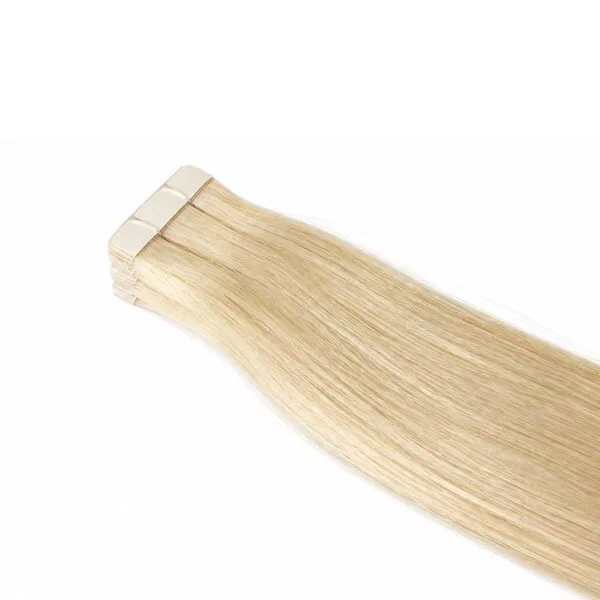
Tape-In Hair Extensions are widely used in professional salons because their flat attachment can distribute added hair across a relatively broad section of natural hair. When the tab size, extension weight, color and installation position are properly matched, the attachment can remain discreet and support a natural transition through the lengths.
However, not all tape-in products are constructed in the same way. Differences in human hair quality, PU tab thickness, adhesive coverage, hair distribution and dimensional consistency can affect installation efficiency and long-term performance. Selecting a suitable product therefore requires more than choosing a length and shade.
This guide explains:
- How Tape-In Hair Extensions are constructed
- How PU tabs and adhesive layers affect installation
- Which natural hair types may suit tape-in applications
- How to select length, weight, density, color and texture
- What professionals should inspect before installation
- How maintenance and removal affect product performance
- Which specifications matter for customized product lines
The most suitable tape-in system is not simply the thinnest or lightest option. It is the product that creates an appropriate balance between attachment area, extension weight, natural hair strength and the wearer’s maintenance routine.
What Are Tape-In Hair Extensions?
Tape-In Hair Extensions consist of sections of additional hair attached to thin adhesive tabs. During installation, a professional stylist isolates a section of natural hair and places it between two matching extension tabs. The two adhesive surfaces meet around the natural hair, creating a flat sandwich-style attachment.
Tape-in systems belong to the broader category of hair extension methods, which also includes wefts, keratin bonds, micro rings, nano rings and removable extensions. The distinguishing feature of a tape-in system is its flat adhesive connection rather than an individual keratin bond or mechanical ring.
The width of the tab distributes the added hair across a broader area than many strand-by-strand systems. This can reduce bulk and create a smooth profile when the tab is positioned correctly and covered by enough natural hair.
The construction normally includes a polyurethane section, an adhesive layer and hair distributed across the tab. Each component affects the finished connection, so product quality cannot be judged by the hair alone.
How Tape-In Hair Extensions Are Constructed
The PU tab forms the base of the attachment. It must be thin and flexible enough to follow the natural shape of the head while remaining stable during installation and wear. A tab that is excessively rigid may feel bulky, while an unstable tab may deform during handling or removal.
Adhesive should cover the intended bonding area evenly. Inconsistent coverage can create weak sections along the edge or center of the tab. Paired pieces should align accurately so the adhesive surfaces meet without exposed edges.
Hair distribution is another important factor. The hair should be secured evenly across the tab rather than concentrated in isolated sections. Uneven distribution can change the weight carried by different parts of the natural hair section and may create visible gaps.
The PU Tape-In Human Hair Extensions supplied by Sasil Hair Products can be specified according to color, length, texture and related product requirements. Before confirming a professional product range, the tab structure and hair specifications should be evaluated together rather than as separate features.
Why the Tab Structure Matters
The tab is the working connection between the extension and natural hair. Its width, height, thickness and flexibility determine how the attachment sits against the head.
A wider tab distributes hair over a larger area, but it also requires enough natural hair to conceal the connection. A narrower tab provides more placement flexibility around curved or limited areas, although more pieces may be needed to create the intended coverage.
Tab thickness affects the attachment profile. A low-profile tab can lie close to the scalp, but reducing material thickness should not compromise handling stability. The most useful design is one that remains flexible while preserving consistent dimensions during storage, installation and maintenance.
PU color may also affect visibility. Transparent or carefully matched bases can reduce contrast beneath the natural hair. However, a transparent tab does not solve poor placement. If the section is installed too close to a visible parting or too near the hairline, the attachment may still be noticeable.
For professional use, the following tab details should be consistent:
- Width and height
- PU thickness
- Edge shape
- Adhesive coverage
- Hair distribution
- Tab flexibility
- Alignment between paired pieces
- Weight of hair attached to each tab
These dimensions should be documented so repeat orders can be compared against an approved reference.
How Tape-In Hair Extensions Compare with Other Methods
Tape-ins are one of several professional attachment systems. Their main advantage is a flat, distributed connection, but other methods may be more appropriate when the client needs individual strand movement or a different maintenance approach.
| Extension method | Attachment structure | Profile | Placement control | Main maintenance consideration | Suitable application |
|---|---|---|---|---|---|
| Tape-in | Flat PU adhesive tabs | Low and flat | Section-based placement | Adhesive care and professional repositioning | Fine to medium hair with enough coverage |
| Flat tip | Heat-activated flat keratin bond | Small individual bond | Detailed strand placement | Professional bond removal | Customized length and volume distribution |
| I-Tip | Extension tip secured inside a ring | Small mechanical point | Individual placement | Opening and repositioning rings | Suitable hair that can conceal the rings |
| Nano ring | Small ring connection | Very discreet point | Detailed placement | Ring inspection and repositioning | Controlled placement with lightweight strands |
| Machine weft | Sewn continuous seam | More substantial | Row-based coverage | Row tension and scheduled refitting | Medium to thick hair requiring broad coverage |
| Hand-tied weft | Thin hand-tied seam | Flexible row | Row-based placement | Weft edge handling | Fine to medium hair when professionally installed |
Tape-In Hair Extensions may be preferable when flatness and distributed weight are priorities. Strand-based methods may provide more freedom for individualized placement, while wefts can provide broader coverage with fewer continuous sections.
No attachment method should be chosen only because it is popular. Natural hair density, scalp condition, styling habits and access to professional maintenance all need to be considered.
Choosing Tape-In Hair Extensions for Different Hair Types
Fine hair can benefit from a flat attachment because the connection may be easier to conceal than a thick seam or large ring. However, fine hair also requires careful weight control. Heavy tabs attached to weak sections can place unnecessary tension on natural hair.
For fine or lower-density hair, the stylist may use lighter pieces, fewer rows and conservative placement. The attachments should remain away from fragile areas around the hairline and other sections with insufficient coverage.
Medium-density hair can accommodate a wider range of tape-in configurations. Selection can focus on the desired amount of volume, extension length and the client’s usual styling routine. Even when the natural hair appears strong, tab weight should remain balanced across the installation.
Thick hair usually requires enough extension density to blend with the natural middle and ends. If the added hair is too light, the natural hair may remain visibly separate. Additional density can be achieved through planned placement, but tabs should not be crowded into a limited area.
Curly and textured hair requires particular attention to texture matching. A visually similar pattern may behave differently after washing or exposure to humidity. Samples should be washed and dried naturally to assess whether the extension texture remains compatible with the intended hair type.
People with actively shedding, severely weakened or irritated scalp areas should receive an appropriate professional assessment before considering semi-permanent extensions. Product selection cannot compensate for natural hair that is not currently able to support added weight.
Selecting the Right Length, Weight and Density
Length and weight must be selected together. A longer extension spreads the same amount of hair over a greater distance, so the ends may appear thinner if the weight is not adjusted appropriately.
When the goal is primarily volume, extensions may be selected close to the natural hair length and positioned in areas that require additional density. When the goal is greater length, the stylist must also create a smooth transition between the natural ends and the added hair.
The natural haircut affects the amount of extension hair required. A blunt haircut may need more blending through the lower sections, while layered natural hair can sometimes transition more gradually into additional length.
Important specifications include total extension weight, weight per tab, number of tabs, finished length and end density. These values should not be considered independently. A light tab may be appropriate for fine hair, but too little total density can produce an incomplete visual result.
Single-drawn and double-drawn hair also create different appearances. Single-drawn hair contains more variation in strand length, producing a naturally tapered effect. Double-drawn hair contains a higher proportion of similarly long strands, creating fuller ends. The choice should reflect the desired finish rather than an assumption that one structure suits every product line.
Color and Texture Matching
Color matching should focus on the natural hair through the middle and ends because this is where the extension must blend. Matching only the root can create an obvious transition, particularly when natural hair includes highlights, balayage or sun-lightened sections.
Mixed shades can reproduce natural tonal variation more effectively than a single flat color. Rooted, highlighted and blended shades may be useful when the natural hair contains visible depth and dimension.
Lighting conditions affect color assessment. Warm indoor light can make neutral or ash shades appear more golden, while cool lighting can reduce the visibility of warm tones. Color should therefore be reviewed under neutral or natural light before installation.
Texture matching is equally important. Straight, body wave, curly and coily patterns differ not only in appearance but also in volume and behavior. A texture should be assessed after washing and drying because packaging and temporary styling may not show its long-term pattern accurately.
Sasil’s hair extension color matching guide explains how undertone, multi-tonal blending, lighting and physical color references influence professional shade selection.
For repeat product lines, a digital color number is not enough. Approved physical color samples should be retained so future batches can be checked against the same reference.
Professional Installation Requirements
Tape-In Hair Extensions should be installed on clean, dry hair without heavy oils or conditioning residue near the roots. Residue can reduce the contact between adhesive surfaces and affect attachment stability.
The stylist begins by creating clean sections that correspond to the tab dimensions. The natural hair placed between two tabs should be distributed evenly. Too much hair can prevent the adhesive surfaces from meeting correctly, while too little hair may place excessive load on a weak section.
The tabs should align so one piece does not extend beyond the other. Exposed adhesive edges can attract residue and nearby strands. Consistent product dimensions make this alignment easier during repeated installation.
Placement distance from the scalp is also important. A tab installed too close to the scalp may feel restricted and fail to move naturally. A connection placed too far away may become visible or rotate.
The layout should account for normal partings, ponytails and styling habits. Tabs should not be placed directly in areas that become exposed during everyday styling.
Professional installation is particularly important for the back and side areas of the head, where accurate sectioning and alignment are difficult to achieve without a clear view.
Comfort, Weight Distribution and Hair Safety
Tape-in attachments should lie flat and move comfortably with the natural hair. Persistent pulling, pain or headaches are not expected signs of a successful installation.
The American Academy of Dermatology advises that weaves and extensions should not feel painful or excessively tight. Repeated pulling can contribute to traction-related hair loss, especially when heavy additions are combined with fragile natural hair or continuously tight styling.
Comfort depends on several connected factors: tab weight, section size, placement distance, natural hair strength and the number of rows. Reducing only one dimension does not automatically solve an unbalanced installation.
Attachments should be checked if the wearer experiences persistent discomfort, scalp bumps, unusual shedding, irritation or repeated tab rotation. A qualified professional should loosen or remove unsuitable sections rather than expecting the scalp to adapt to excessive tension.
Daily Care and Maintenance
Tape-In Hair Extensions need a care routine that protects both the human hair and the adhesive connections. Brushing should begin at the ends and move upward while the root area is supported. A brush should pass through the lengths without catching the tabs.
Hair can be washed using controlled downward movements. Aggressive circular rubbing near the scalp may twist tabs and neighboring strands together. Conditioner and treatment masks should be concentrated on the middle and ends rather than placed directly over the adhesive area.
Oils, heavy serums and rich conditioning products should be kept away from the tabs. Even a stable adhesive connection may be affected by repeated exposure to residues that migrate into the bonding surface.
Hair should be dried thoroughly before sleeping. Wet hair is more vulnerable to tangling, and moisture around the root area can make the attachments more difficult to manage. A loose braid or low ponytail can reduce friction without creating excessive tension.
Heat styling tools should not contact the tabs. Direct heat may affect the PU base or adhesive layer. Controlled styling can be applied to the middle and ends when the human hair condition permits it.
Maintenance appointments should be arranged according to natural hair growth and attachment condition. As the natural hair grows, the tabs move farther from the scalp and may become more visible or less stable. They should be professionally removed and repositioned rather than left in place indefinitely.
Removal and Reinstallation
Removal should use a product and method compatible with the adhesive system. The remover is applied to the attachment, allowing the adhesive connection to release without forceful pulling.
The tabs should be separated patiently. Pulling before the adhesive has released may place unnecessary stress on natural hair. Any remaining residue should be removed carefully before the hair is cleansed and prepared for another installation.
Naturally shed strands may collect between the attachment and scalp during wear. This is expected because hairs that would normally fall away can remain held near the tab. They should be separated gently during removal rather than treated as a single knot.
Before reinstallation, the extension hair and PU tabs should be inspected. Hair with significant tangling, breakage or weakened attachment areas should not automatically be reused. Replacement adhesive must also match the tab dimensions and intended application.
The natural hair should be checked for breakage, irritation and uneven density before another set is installed. Repositioning the tabs can help avoid repeatedly loading exactly the same sections.
How to Evaluate Tape-In Hair Extension Quality
A professional evaluation should examine the hair, PU base and adhesive system separately before assessing how they work together.
Begin by measuring several tabs from different parts of the order. Width, height and weight should remain consistent within the confirmed tolerance. Paired pieces should align without trimming or manual adjustment.
Dry brushing can reveal unusual shedding or loose short strands. The product should then undergo a controlled wash test to assess texture, tangling, color release, coating residue and drying behavior.
The PU tab should remain stable during normal handling. Its edges should be clean and the hair should be distributed evenly across the attachment. Adhesive coverage should be consistent without missing areas or substantial overflow.
A suitable inspection checklist includes:
| Inspection area | What to check | Why it matters |
|---|---|---|
| Tab dimensions | Width, height and edge consistency | Supports accurate pairing and predictable placement |
| Weight per piece | Variation between sampled tabs | Helps control load distribution |
| PU base | Flexibility, thickness and stability | Affects comfort and attachment profile |
| Adhesive coverage | Even surface and clean edges | Influences bonding consistency |
| Hair distribution | Even density across the tab | Prevents weak or overloaded sections |
| Dry brushing | Shedding and short strand release | Reveals initial construction issues |
| Wash testing | Tangling, residue and texture change | Shows performance beyond initial appearance |
| Color consistency | Comparison with approved sample | Supports repeat-order continuity |
| End density | Fullness through the lower lengths | Affects blending and finished appearance |
A product that feels smooth when first unpacked has not necessarily passed a meaningful quality assessment. Washing and drying provide more useful evidence than initial softness alone.
Tape-In Hair Extensions for Professional Product Lines

Salons, distributors and private-label brands need specifications that can be repeated, inspected and communicated clearly. Descriptions such as “thin tape” or “natural color” are not precise enough for consistent production.
A tape-in product specification should confirm:
- Hair material and processing level
- Finished length
- Weight per tab
- Number of pieces per set
- PU tab dimensions
- Adhesive requirements
- Color reference
- Texture standard
- End density
- Packaging and labeling
- Inspection tolerances
When developing a customized line through Sasil’s OEM and ODM services, the approved sample should become the physical reference for production. Written specifications and physical samples work together: the document defines measurable requirements, while the sample confirms visual and handling expectations.
The wider range of human hair extensions can also help professional users compare tape-in systems with keratin, ring and weft alternatives before defining a complete product portfolio.
Common Selection Mistakes
One common mistake is selecting Tape-In Hair Extensions only according to length. If weight, end density and natural hair thickness are not considered, the final result may look disconnected even when the shade is correct.
Another mistake is assuming that the thinnest tab must be the most comfortable. Tab flexibility, stability, hair weight and installation technique all contribute to comfort.
Using too many tabs on fine hair can create unnecessary tension and make the connections difficult to conceal. Using too few on thick hair may create an incomplete blend. The number of pieces should be based on the natural hair and intended result.
Color numbers should not be treated as universal standards. A shade number may represent different undertones between suppliers, making physical sample confirmation essential.
Finally, maintenance expectations should be discussed before installation. Tape-ins require careful product use, professional removal and scheduled repositioning. A client who cannot follow this routine may be better suited to a removable method.
Conclusion
Choosing Tape-In Hair Extensions requires a balanced assessment of natural hair strength, tab structure, adhesive coverage, extension weight, length, color and maintenance expectations. Their flat profile can support discreet blending, but only when the product specifications and installation method work together.
For professional product selection, the PU base and adhesive system deserve the same attention as the human hair. Consistent tab dimensions, even hair distribution, verified wash performance and approved color references help create predictable results across repeat applications.
A successful tape-in system should not depend on broad quality claims. It should be supported by measurable specifications, representative samples, appropriate installation and a maintenance routine suited to the wearer’s natural hair.
FAQ
Are Tape-In Hair Extensions suitable for fine hair?
Tape-In Hair Extensions may suit fine hair because their flat tabs distribute added hair across a broader section. However, the pieces must be lightweight, correctly positioned and limited to areas with enough natural hair for support and coverage. Fragile or actively shedding hair should be professionally assessed first.
Can Tape-In Hair Extensions be reused?
Some tape-in extensions can be reused when the human hair and PU tabs remain in suitable condition. The original adhesive is removed and replaced before professional reinstallation. Each piece should be inspected for tangling, shedding, weakened tabs and uneven hair distribution before reuse.
Why do tape-in extensions slip?
Slipping can result from residue on natural hair, uneven sectioning, excessive hair between the tabs, incorrect alignment, product applied near the adhesive or inconsistent bonding surfaces. The cause should be identified before the attachment is replaced rather than assuming that every case comes from the adhesive alone.
How should Tape-In Hair Extensions be washed?
The hair should be washed with controlled downward movements while avoiding aggressive rubbing around the tabs. Conditioner, oils and rich treatment products should remain on the middle and ends. The roots and attachment area should be dried thoroughly before sleeping or styling.
What specifications are important for customized tape-in extensions?
Important specifications include hair material, length, weight per tab, tab dimensions, adhesive requirements, color, texture, end density, packaging and acceptable tolerances. An approved physical sample should be retained to support quality comparison during repeat production.